
A vast similitude interlocks all,
All spheres, grown, ungrown, small, large, suns, moons, planets,
All distances of place however wide,
All distances of time, all inanimate forms,
All souls, all living bodies though they be ever so different, or in different worlds…
–Walt Whitman¹
Hannah Rickards’s artistic practice studies the relationship between perception and experience. Resistant to the construction of narrative, she employs a range of conceptual tools and media to create works that measure the limits of language and map conditions of uncertainty in our attempts to discern and describe the world. While her projects have often analyzed natural phenomena – for example, dissecting the sound of a thunderclap or plotting a community’s disparate testimonies of a witnessed mirage – they have been less focused on the phenomena themselves than on generating a set of theoretical frameworks for apprehending them.
Rickards’s solo exhibition of new work at the Gibson Art Museum marks a subtle but significant shift in the artist’s focus, occasioned in part by her move in 2022 from London, UK, to an acreage in Syilx Okanagan territory in the Interior of British Columbia. Life in this new context, with its markedly different tempo and scent – a rural valley thick with orchards, pasture, and lumber mills, encircled by rocky benchland – invoked a kind of metabolic shift in the artist’s approach. While the question of where and how we place our attention has always been fundamental to Rickards’s work, I am the infant and I am the bird invites an uncoupling from contemporary culture’s relentless “attention economy” to invite a consideration of how we might more carefully attend to the world’s ways of revealing itself to us.
Rickards’s installation is characteristically spare. Mounted across two of the Gibson’s galleries, the videos and still images are lit only by daylight, tinged pink by a translucent film applied to the rooms’ narrow windows. Lengths of reflective orchard tape, omnipresent across the Okanagan region, flutter softly at the floor vents. Marking the entrances to each space, and serving as a sort of guide between them, is a free-standing monitor. The video works on these screens show only monochromatic fields of grey, as the footage was recorded in the weak light before dawn, but at rare moments the form of a hummingbird appears, barely discernible, hovering within the frame as though suspended in time. Viewers intent on moving quickly into the galleries will miss this encounter altogether; the exhibition rewards a willingness to slow down.
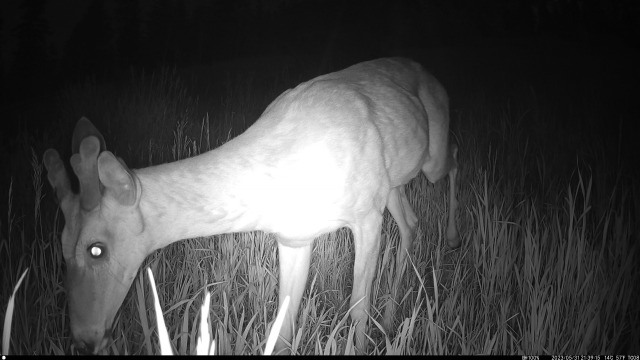
The centre of the large gallery is anchored by a single-channel video work. Visitors are invited to regard Figure Ground (2025) from a set of weatherworn bleachers transported from Rickards’s property, where they normally stand, witness to the seasonal shifts (whether drifting snow or wildfire ash), facing the mountain ridge. Figure Ground depicts nighttime footage gathered over years by an infrared trail camera erected in Rickards’s pasture. Triggered by motion, the camera does not differentiate between the types of activity it detects. Depending upon the duration of their visit, viewers may experience the erratic flight of a moth, a grazing deer that pauses to stare arrestingly at the camera, or just long stretches of wheat grass nodding in the breeze.
Present here – as in all of Rickards’s works – is the influence of experimental twentieth century composer John Cage. By attuning his audiences to everyday sounds and embracing chance as a compositional strategy, Cage proposed a radical reconsideration of the parameters of music.² Similarly, Rickards’s actions are restrained; she limits authorship to the creation of “empty” frameworks within which the world reveals itself. By enabling non-events to be perceived, the artist invites viewers to resist imposing any hierarchy of vision or meaning.
The photo-lithographic-and-silkscreen prints hung in the small gallery offer further evidence of Rickards’s experiments in patience and releasing control. This series, titled To enable me to fix my attention on any one of these symbols I was to imagine that I was looking at the colours as I might see them on a moving picture screen (2025), was generated using remote viewing, a paranormal practice of perceiving a distant or hidden subject without the aid of the senses. To create these works, Rickards enlisted the help of friends who were in locations unknown to the artist. At a pre-agreed time, the friend became attentive to their surroundings while elsewhere Rickards sat alone at her desk, attuned to shapes, lines, and textures that arose in her mind’s eye, drawing them without attempting to give them meaning. Only later, when the friend sent a photograph of their location, would Rickards discover echoed forms in her own drawings. For Rickards, her role in the exercise was analogous to that of the trail camera: an open awareness through which images pass and are translated into visible form.
In its alertness to the vitality of the world, I am the infant and I am the bird shares much with early interpretations of photography. For the first decade of its existence, the photographic image was understood not as “captured” or “taken” but rather as something “received from the world.” As William Henry Fox Talbot observed in an 1839 letter, “It is not the artist who makes the picture, but the picture which makes itself.”³ Photographers were obliged to wait patiently for their images to appear and often spoke of an inability (chemically and psychically) to fully control or fix the medium. In a recent re-examination of the history of photography, film theorist Kaja Silverman suggests that while conventional readings emphasize photographs’ stasis (i.e., their demonstration of “this-has-been” and “this-is-no-more”), we would be wiser to approach photography as “the world’s primary way of revealing itself to us—of demonstrating that it exists, and that it will forever exceed us.”⁴
The cyclical waxing and waning of tinted daylight inflects visitors’ readings of I am the infant and I am the bird, and ensures it will never be experienced twice in precisely the same way. Infused with the imperceptible temporalities of both hummingbirds and the glaciers that shaped the Okanagan Valley, Rickards’s works remind us that we are part of an interconnected world that is alive and in constant movement. And while, as Silverman stresses, humans are reluctant to acknowledge some of these similarities, particularly those that call our primacy into question, photography is the vehicle through which such unsettling but important relationships are revealed to us. “Photography analogizes the analogies that reside at the heart of human perception: those through which we see and are seen,” she notes, “helping us recognize what we might otherwise foreclose.”⁵
