
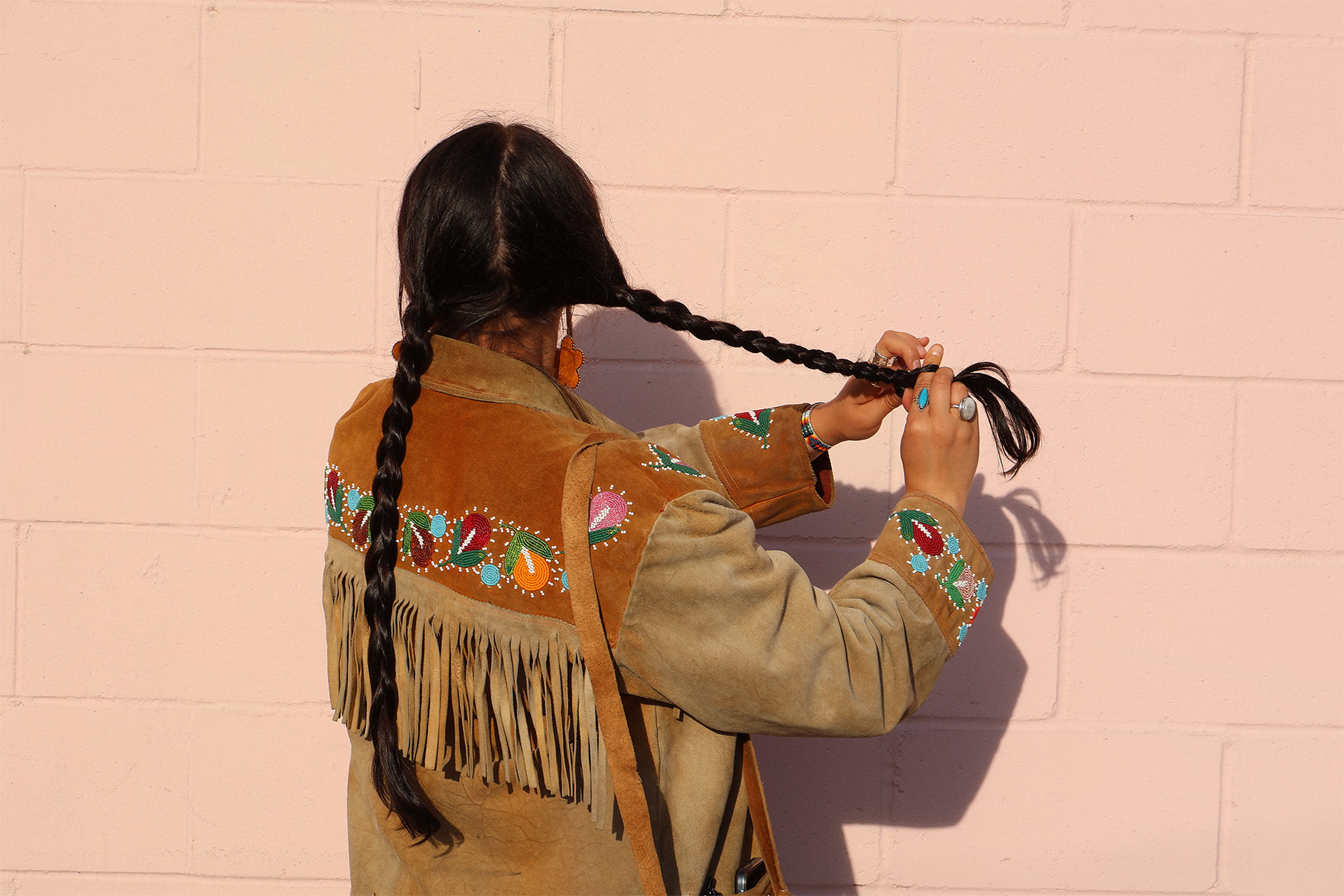
The first thing I notice about Michelle Sound’s photograph Wherever You Are (2026) is the subject’s hair. I’m looking at the back of Zoe Ann Cardinal Cire’s head. One braid, fully completed, falls down her back, longer even than the fringe that runs across the middle of the hide jacket she wears. Her shadow is cast on a dusty pink wall in the background. Most of Cardinal Cire’s shadow is amorphous, covered by her body, except for the clear shape of the ends of another section of hair that she holds out at an angle, her fingers working it into another braid. This piece of hair explodes into a tuft, which is then doubled in a shadow on the wall. It is an extension of herself. Her hair moves beyond what is held in her hand and attaches itself, if only briefly, to the building of the Pink Pearl restaurant on East Hastings. At the same time, since nehiyawak hair holds memories and is one of many connections to our homelands, this photo shows something not pictured: Cardinal Cire’s home community in Treaty 6 territory, over a thousand kilometres away. The hair doubling, of subject and shadow, signals her ability to be in, at least, two different locations at once.
The next thing I notice, of course, is the jacket. It is tanned hide and two-toned, mostly beige with darker brown pieces for the cuffs and upper back. It’s not often that a photograph can evoke a smell, but this one does. I know that it’s naturally smoked hide because of the way sections of the beige hide bloom darker, places where more smoke would have naturally gathered. I can smell the smoke this jacket holds through the screen of my computer, long after I look away from it. Intricate beadwork, blue circles, and bulbed red, orange, and pink flowers spread across the shoulders of the jacket, where you can imagine an arm would lie if it were draped across Cardinal Cire’s shoulders. This beadwork continues across the cuffs. Preparing a hide in this way and beading with such detail takes time. When I look at this jacket, I see hours upon hours of labour, patience, and preparation. I see a kind of care that comes from dedication.
This is by all accounts and definitions a beautiful jacket, both aesthetically and in craftsmanship. It reminds me of a teaching my Elder, Jo-Ann Saddleback, often shares. She says we should always dress for the Creator, that we need to sparkle and shine so bright that Creator can’t miss us. I think about this teaching when I see Michelle Sound wearing a pair of earrings as big as her head; I think about this teaching when I see someone wearing Cheyenne Rain LeGrande’s signature platform moccasins; I think about this teaching when I wear a camouflage print ribbon skirt to ceremony, because I feel more aligned with my gender in darker colours. And I think about this teaching as I look at this photo of Cardinal Cire wearing a jacket so beautiful that it certainly could be seen from the stars.
I am reminded, too, of another teaching from nôhkom Jo-Ann Saddleback. She says that nehiyawak have always understood our bodies to be a canvas. Traditionally, nehiyawak travelled year-round. We are moving people, people in motion with the seasons, with trails cut across territories leading to bodies of water and medicines. Because of this, the only way to carry our art with us was to put it on our bodies. In Michelle’s photo, Cardinal Cire is captured in movement as she braids her hair, which makes me think about the importance of movement to our dress, to our bodies, and to the way we have always claimed space in the world: dressing for the Creator while we make our way to our next destination.
Wherever You Are is a photo that looks timeless, like it could have been taken anywhere at any time. It is at once, and repeatedly, everywhere and always. With Cardinal Cire’s back turned, without a face to place her, it also feels like she could be anyone, from any nation, any gender, any community. The effect of this, of course, is recognition. I look at this photo and I see my aunty in High Prairie in the 1980s. Someone else might look at the photo and see themselves or their kin in another place and at another time. This is all to say, this photo makes me think of someone I intimately know. It makes me think of my family. It allows the relief that comes with recognition.
Yet it does all of this without falling into the trap of pan-Indigeneity. Though this photo looks like it could be anyone anywhere, there is, at the same time, too much specificity for that to be true. Like thumbprints or strands of DNA, unique patterns come from specific communities, so the beaded flowers on Cardinal Cire’s jacket are unlike the flower designs from my community, even though our nations are only 350 kilometres apart. Everything from the pattern, to the tones in the smoked hide, to the position and length of the fringe, tells a story about who Cardinal Cire is and where she is from, even without revealing her face.
In this way, our clothing, like our hair, is also a compass pointing to where Capture 2026 24and who we are from, a direction to family and lineage and name. Wherever You Are, then, is as much a time travel piece as it is a photo of Cardinal Cire braiding her hair and wearing a beautiful jacket, bringing us through time, memories, and life in Treaty 6 territory to a shadow cast on a dusty pink wall at the Pink Pearl restaurant in East Vancouver.
