
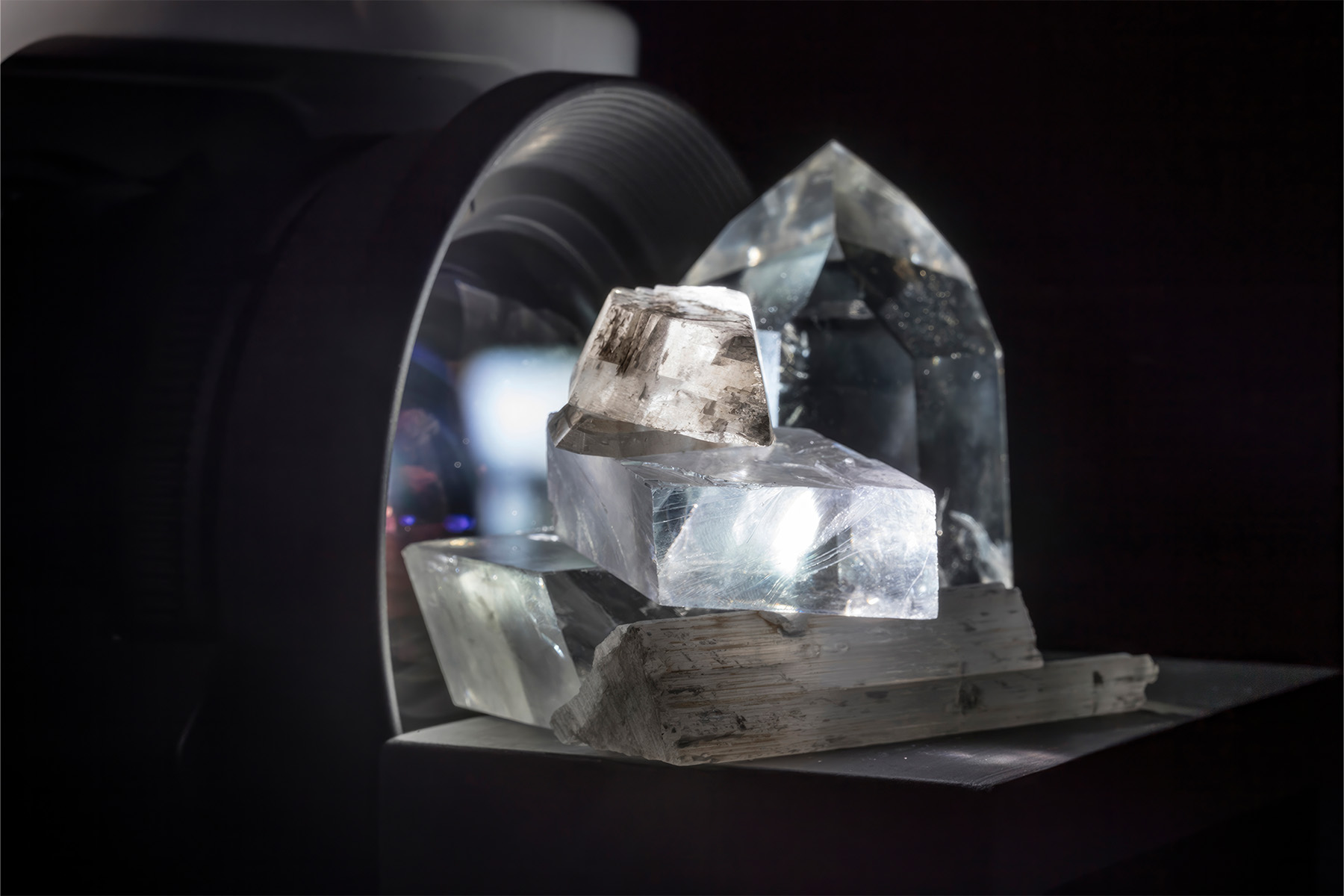
Photographic images have captured mere seconds and minutes of the ancient story of the sun on the land. Light has been making life, images, shadows and reflections for billions of years. Those photographs are called stones – geological formations – the grandmothers and grandfathers embodied in the volcanic rocks used in sweat lodges. The deep time represented in stones is the time frame of spirit and ancestral knowledge. But we are human, and our stories and memories are restricted by our own lifetimes and the length of narrative and remembrance. The extensive collection of recent human experiences caught in bits of silver by small exposures to universal events and the passage of light draws us into stories, to see our own reflections or lack of them.¹
So begins Tania Willard’s catalogue essay for the 2016 exhibition Nanitch: Early Photographs of British Columbia from the Langmann Collection, co-organized by Presentation House Gallery (now The Polygon Gallery) and the University of British Columbia Library.
While this essay reflects on a historical collection of photographs, Willard’s words have proven foundational for much of her practice in the intervening years and certainly for my work with her as a curator.
The first segment of Willard’s essay (“Grandmothers and Grandfathers”) challenges the notion of what is “early” and what came first in photography, as Willard casts aside the often repeated notion that photography begins in the early nineteenth century with attempts to fix various impressions etched by light on chemically sensitized surfaces. As she notes, “fixed moments on paper have done much to undermine Indigenous rights,” referring not only to photographic images but also to titles and treaties. Instead, Willard reminds us of the lasting effects of light on land – geological formations – which can be dated back billions of years. At stake here is the history – and therefore the present and future – of the very lands and communities where Willard was born and belongs.
European photography – in the form of surveillance, anthropology, and advertising for settler recruitment – consistently aided the colonial process, and thereby interrupted millennia of Indigenous tradition and innovation throughout what relatively recently came to be called British Columbia. Yet Willard does not propose a simple return to a past before colonialism. Rather, reflecting on the future, she investigates the socio-political context beyond the frame of historical photographs. And she steers optic vehicles of violence toward other ends.
The second segment of her essay (“History is a Pile of Stones”) offers this constructive prompt: “If we look at these images carefully we can see behind the dominant narrative. We can peer into the shadows and backgrounds, leaving the foreground as evidence of the ways in which photographs suggest, evoke, construct, and fictionalise.” The third segment (“Clearing Stones”) considers acts of colonial erasure in imaging and land use, attending closely to one photographic album in the Langmann Collection, which is devoted to the community of Walhachin in Secwépemc territory (which is tellingly mislabelled). We learn that the settlers’ failure to acknowledge and portray, let alone learn from, the generations of Indigenous people nurturing life in these lands spells their failure to establish their desired “Canadian Camelot,” but not before great damage is done. The fourth segment (“Stones as Grave Markers”) considers further the problematic fixation on photographing Indigenous burial sites and confronts the myth of “the vanishing race” – convenient only for the colonist – with an image of 3,500 First Nations people gathering to deal directly with the Crown, in the week of the Queen’s birthday, in the pivotal year of 1864.²
Willard concludes her 2016 essay with an interruption of her own, this time to the entire logic of what she sums up as the settler lens. In the last segment of her essay (“Stones Are Time Travellers”) it becomes clear that she is offering not simply a new image but an entirely new way of seeing: “Distance can allow us to reshape our vision. All of this is measured and told through light on the land.” A new measure – another dimension – is sought and found. Rather than rejecting photography as a colonial tool, Willard reimagines it along lines summed up in this conclusive paragraph:
An image is “recorded” by our eyes, on photographic film, via cathode rays, or in tree rings and stones acting as witnesses to deep time and the effects of light on matter. Whether biologically, chemically, or electronically recorded, image formation depends on what bits of light we can translate and read. A stone represents the entire set of processes involved in the formation of the Earth; we can read deep time through understanding and examining the geological conditions in which it was made. A photograph can similarly be read in terms of its paper and chemistry, its format and borders, its construction and composition, its subject matter and sociopolitical context. If you look in this way, with knowledge and balance, then a photograph, like history, is as heavy as stone.³
As the interplay of light and lithic life – stones, minerals, crystals – guides Willard’s reframing of historical time and photography, we call her show Photolithics. A neologism (combining ancient words for “light” and “stone”) was necessary to signal a paradigm shift. Like economics, politics, aesthetics, and physics, photolithics may be understood as a faculty, a discipline of making and of understanding the world. From Only Available Light (a 2016 video installation involving the re-presentation of Harlan I. Smith’s film The Shuswap Indians of British Columbia from 1928) to her most recent photographic series, Through and Through (which began in 2025 and features her own photographs of Secwépemc lands), Willard often chooses to perceive and project through crystals. The resulting interruptions and refractions go well beyond the postmodern gesture of deconstruction. They are an act of honouring the vitality of each person and place depicted.
Willard’s compositions involving historical photographs or films are a particularly sensitive terrain, as they show vistas once framed so as to be colonized, as well as people and their creations once captured so as to be killed – if not literally, then culturally. Re-presenting such images runs the risk of inflicting great damage; they carry the memories of the settler lens. Yet the act of remembering is also, always in Willard’s case, an act of transformation. She hones her vision through gathering friends and berries, tending to garlic and many other plants, tanning hides, studying, and always thinking through making. In this continued assertion of belonging (rather than ownership), the land is not simply an image. The land becomes a lens.⁴
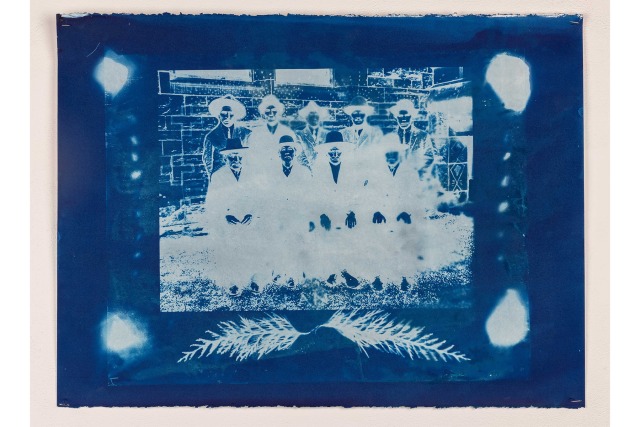
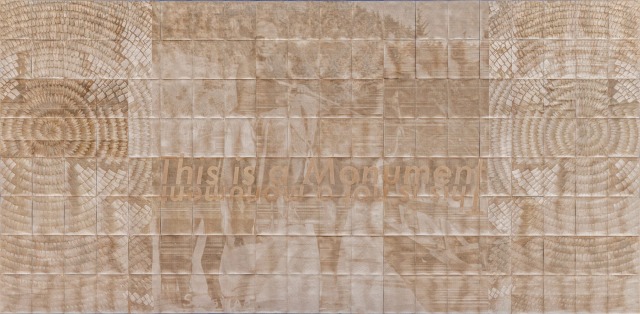
Willard’s exhibition is conceived to traverse ten years of practice – multifaceted, like a gemstone – with a focus on photography. An important point of departure is the 2022 work entitled Vestige, made some years after the Nanitch catalogue essay was written, yet using a postcard Willard found while researching the Uno Langmann Family Collection of BC Photographs – and then found again in a family archive, this time with the following inscription on the back: Sophie Paul – died in mid 30s, the sister of tskwayásxn, Neskonlith Reserve. Willard scanned that postcard and printed Vestige – or rather laseretched it across 160 sheets of garnet sandpaper – at a vastly expanded scale of 88 x 180 inches. If a European comparison is useful, this is the scale of history painting. But this is a new order of imaging asking us to look and consider what remains of historical materials differently.
The copper- and sand-toned image takes time to cohere when looked at, refusing the fast consumption of a postcard photograph. We can make out a woman sitting on a horse, reins and whip in hand, turned and looking steadily at the camera while the horse looks ahead. Behind them is a hill lined with trees.⁵ At bottom, off-centre, the postcard publisher’s inscription reads “Shuswap Native.”⁶ Yet the etched sandpaper, made up as it is from abrasive garnet minerals and thus a product of the land, proves as tough to define as it is to touch.
“This is a Monument” can be made out in a large modern font superimposed by the artist at centre. And if this immediately calls up equestrian statuary, with all of their historical weight, Vestige does not fit comfortably into the colonial canon of mounted generals and kings. Colonial queens or noblewomen, when depicted astride a horse (and this was rare), were seated side-saddle, implying limited command. By contrast, Sophie Paul straddles her horse with visible balance and calm confidence. Underneath, upside down, and therefore mirroring the above declaration, we read: “This is not a monument.” There is no one way of looking at Vestige, and it cannot be situated neatly on a timeline. As if to underscore the alternate shape of spacetime at play, the central equestrian portrait is flanked by two photographs made by Willard – or rather one image, doubled and mirrored – showing the expertly woven lid of a basket. Step back and these twin close-ups of cedar roots, coiling well beyond the bounds of the photographic print into what seems like infinity, look back at you, stone-faced, like the woman on the horse.⁷
A key passage from Willard’s master’s thesis elucidates the transgenerational agency of this and other works:
I am accompanied by dreams of ancestors. In this research I seek to reawaken these dreams into a reality wherein our people are empowered and our histories are recognized, our land claims are honoured and our belongings and ancestral remains returned. Of course this is a tall order, but it is in faith of the ways in which our work resonates, the metaphysics (Frideres 42) of ancestral knowledge that I place this dream. I like to think that part of our ancestors’ rationale for depositing their knowledge in museums was that they dreamed that one day we, as future grandchildren, would find this knowledge and bring it back. My Aunty, Joyce Willard, has said of Isaac Willard’s work with anthropologists and his depositing of archaeological finds to the Kamloops Museum and other institutions that he had told her it was more like a temporary housing until our people could take better care of these things (in a period of extreme social distress prompted by colonization). It is this greater responsibility that informs my work.⁸
Tania Willard’s continued attention to belongings (found in family collections, archives, and museums) and belonging (to land and community) constitutes a kind of lucid dreaming. Her works of art weave together several specific times and spaces, spanning the distance between the artist, her elders, and her ancestors. To make room for her works – the paradigm shifts they summon and the community they reflect – a presenting institution needs to emphasize how Willard’s images may be looked at, but more importantly, how they are there to be looked through, at the waking world. Finally, considering how they look back in turn.
The forms of woven vessels, which flank the central figure in Vestige, and which recur throughout Willard’s work, are emblems of an ancient yet continuously evolving geometry. They carry clues to linking past, present, and future innovations in ethics and aesthetics – in other words – Indigenous world views. As I write, Willard prepares a summation of her ongoing historical research into interior and coastal Salish basketry from photographs she has made in collections, historical documents, and conversations with friends, thus honouring ancestor artists unnamed and named. Configured into a window treatment for the entirety of The Polygon Gallery’s main exhibition space, the signature weaving patterns unite the function of image and lens. They are printed on transparencies and cut vinyl so as to let the sun in to do its work.
